Prepare for the everyday parts of a China trip: your arrival card, high-speed rail, payment, eSIM, emergency numbers, food, hotel check-in, apps, and clear communication. First-time visitors often find that the biggest surprises are not the landmarks but the small systems around them: completing an entry step, scanning a QR code to pay, reading station signs in Chinese, or knowing which number to call. Each guide gives you a concrete next step and points back to current official or provider information when rules can change. Ask-China brings practical guides together with Dining, the app capability available now.
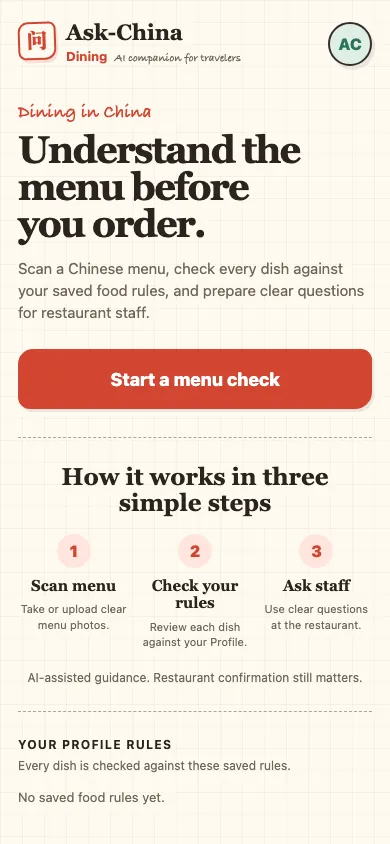
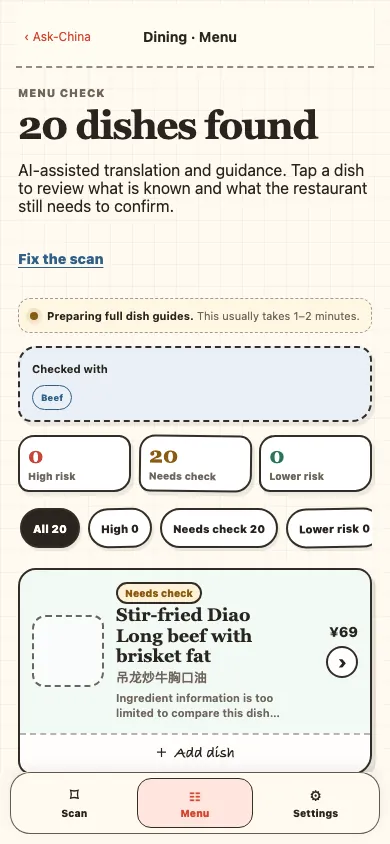
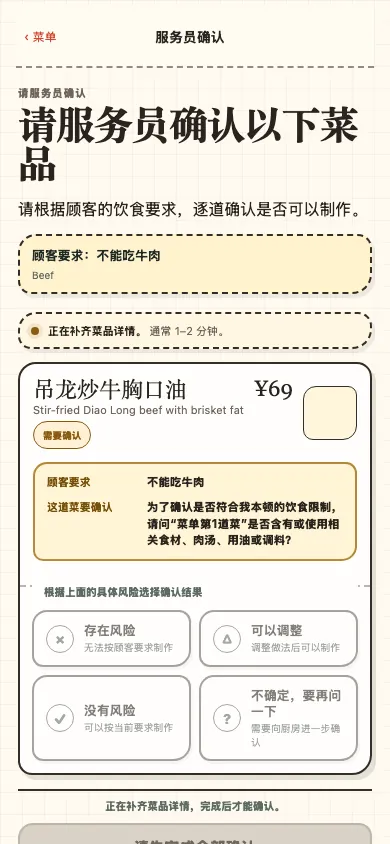
Ask-China Dining helps travelers scan Chinese menus, review dishes against saved preferences, and prepare bilingual questions for restaurant staff. It works with the formats travelers actually meet: paper menus, wall menus, and QR-code menu screenshots, and it keeps allergies and dietary rules saved between meals. The restaurant must still confirm ingredients, availability, and safety-critical dietary needs.
Prepare the everyday sequence, not only the itinerary.
A first trip becomes easier when the practical pieces work in the right order. Your phone connection supports maps and payment verification; written Chinese place names support transfers and check-in; a payment backup helps when one method stops working during your first meal or ride. Use this sequence to prepare the moments between the landmarks, then open the detailed guide for the situation in front of you.
Before you travel
Make the essentials work while you still have time to test them.
Do the account, document, and connectivity work before departure. Airport Wi-Fi and a tired arrival are poor conditions for recovering an account, comparing a booking name, or discovering that a card needs another verification step.
01
Prepare your arrival card and booking details
Use the official National Immigration Administration channel to check whether you need an arrival card and how to submit it. Keep your passport-name spelling, arrival transport details, first address in China, and hotel booking together in an offline note.
Confirm that your phone is unlocked, your chosen SIM or eSIM supports the places you will visit, and your home number can still receive essential verification messages. Install important apps from official stores, sign in once, and save provider instructions offline. Keep a second way to connect for late arrivals or transport changes.
Prepare one mobile payment method and one separate fallback such as another eligible card or some RMB cash. Use the official app and your card issuer to confirm current eligibility, limits, and verification. Test with a small purchase before relying on the setup for a hotel deposit, long journey, or group meal.
Reduce the number of decisions you must improvise after arrival.
Your first day connects several systems at once: transport, maps, payment, hotel registration, language, and food. Prepare the hand-offs between them so one small problem does not turn into a chain of delays.
04
Save destinations as Chinese text
Keep the hotel, station, attraction, entrance, and pickup point in Chinese text—not only as an English nickname or map screenshot. Add the full address and a nearby landmark when useful. Written text can be copied into a map, shown to a driver, or checked by station staff even when pronunciation or mobile data fails.
Before leaving the airport or station, open the booking, confirm the property address, and check the late-arrival message. At the desk, clarify the room, deposit, refund method, breakfast, Wi-Fi, and checkout time before you walk away. Ask staff to write down any amount or timing you may need later.
Save one short Chinese note for your dietary needs and ask one concrete question at a time. A translation can help you identify a dish or prepare a question, but only the restaurant can confirm current ingredients and kitchen practice. When a restriction is important, choose a simpler dish if the answer remains unclear.
Keep China's police, fire, ambulance, and traffic-accident numbers in an offline note. Add your current hotel or destination address in Chinese so you can state or show your location quickly.
Choose the question you actually need to solve. Payment, phone setup, language, hotel arrival, transport, and food each require different preparation. Each guide is written around one practical question, so you can finish it in a few minutes and move on to the next item on your list. Provider and booking rules can change, so confirm time-sensitive details with the relevant service.
Practical guides
Find the answers first-time visitors need before they arrive.
A practical China arrival card guide: official online and paper options, what information to prepare, common mistakes, and how to avoid fake fee-charging websites.
A China eSIM guide for travel: compare compatibility, activation, coverage, data needs, SMS access, and backup options without relying on an unverified “best” ranking.
How to get around China without speaking Chinese: save written destinations, use map-ready addresses, confirm entrances and pickup points, and keep a backup route.
Tell us the city, timing, and what you are trying to do. Your request is emailed to the Ask-China inbox. If a helper is able to respond, you may receive an email. Replies and response times are not guaranteed.